Solid Brass Cabinet Hardware
Cabinet hardware is the part of a kitchen, wardrobe or piece of furniture that is touched every single day. It is also the part that is easiest to change. Swapping tired handles for solid brass ones costs a fraction of a new kitchen and changes the character of the room more than almost any other small alteration.
Everything in this category is made from genuine solid brass. Not zinc alloy with a brass-coloured coating, and not steel with a thin plated layer that wears through at the edges. The material goes all the way through, which is why these pieces have real weight in the hand and why they age instead of peeling.
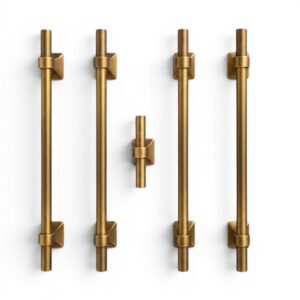
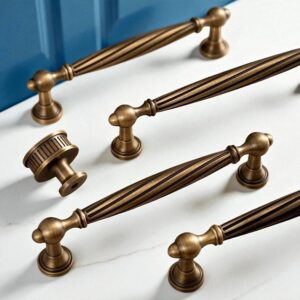
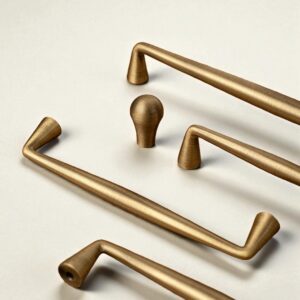
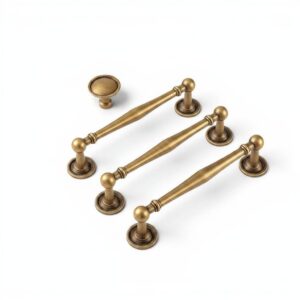
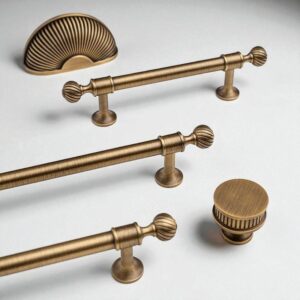
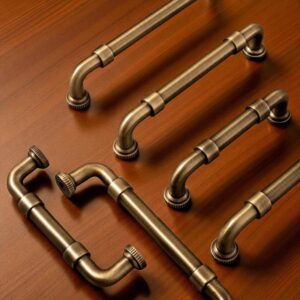
The range covers knobs, handles, pulls, T-bars and drop pulls in a spread of centre-to-centre sizes, in aged, antique, brushed, gold and knurled brass finishes. Whether you are replacing eight handles on one run of drawers or fitting out a full kitchen, the sizing information below should help you order the right thing the first time.
What Counts as Cabinet Hardware?
The words are used loosely, and different suppliers mean different things by them. Here is how the terms are used across this catalogue.
Cabinet and Drawer Knobs
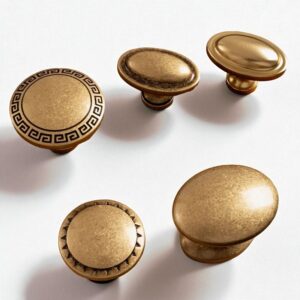
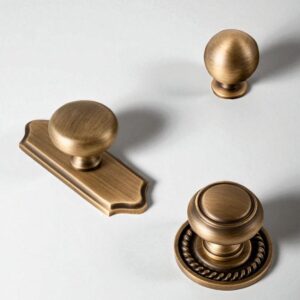
A knob has a single screw and a single hole. It is measured across its widest point rather than by hole spacing, and the sizes in this range run from roughly 15 mm up to 45 mm. Small knobs suit glazed cabinet doors, interior joinery and delicate furniture; larger ones sit better on full-height wardrobe doors and heavy drawers where a small knob would look lost.
Because a knob only has one fixing point, it is the simplest hardware to fit and the most forgiving if your existing holes are irregularly spaced. It is also the easiest to change your mind about later.
Handles and Pulls
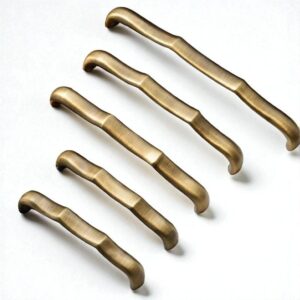
A handle has two screws and is measured centre to centre, from the middle of one hole to the middle of the other. This measurement is the single most important number when ordering, and it is what the size options on each product refer to. The common sizes in this range are 96 mm, 128 mm, 160 mm, 192 mm, 224 mm and 320 mm, with the imperial equivalent shown alongside each one.
The overall length of a handle is always greater than its centre-to-centre measurement, because the ends extend past the fixing points. If you are working to a tight space — beside a wall, next to an appliance, or where two drawers meet — check the overall length as well as the hole spacing.
T-Bar Handles
A T-bar sits on a single stem with a bar across the top. Visually it behaves like a knob, but it gives more to grip, which makes it a good compromise on drawers that are pulled open dozens of times a day. In this range T-bars are listed by their overall length rather than by hole spacing, since they fix through one hole.
Drop Pulls and Ring Pulls
A drop pull hangs from a single fixing and falls back flat against the drawer front when it is not in use. It is a traditional form, closely associated with antique and reproduction furniture, and it works particularly well on small drawers where there is not enough width for a handle. Drop pulls are measured by drop length — how far the moving part hangs below the fixing.
Genuine Solid Brass, Not Plated Zinc
Most inexpensive cabinet hardware is cast zinc alloy with a brass-coloured finish applied on top. It looks convincing in a photograph and for the first year or two on a cabinet. The difficulty comes later, at the points where fingers land: the coating thins, then breaks, and a grey or silvery patch appears that cannot be polished out because there is no brass underneath to polish.
Solid brass behaves differently because there is no coating to lose. The surface changes over time — it darkens, softens and picks up the marks of being used — but it changes as brass, not as a failing finish. A worn edge on a solid brass handle reads as age. A worn edge on a plated one reads as damage.
How to Tell Solid Brass from a Coated Imitation
Weight is the most immediate test. Solid brass is noticeably denser than zinc alloy, and the difference is obvious the moment two similar handles are held one in each hand. Temperature is the second: brass feels cold when first picked up and warms slowly.
The third test is the underside. On plated hardware the back and the inside of the screw holes are often left raw, so the base metal shows through as dull grey. On solid brass the same yellow metal continues right through the piece.
How Solid Brass Ages
Left alone, brass develops a patina. It begins as a slight deepening of colour and, over years, becomes a darker and more varied surface, more pronounced in recesses and around knurling than on the flat faces that get handled. Some people polish it back; others buy brass precisely because it does this. Neither is wrong, but it is worth deciding which you want before choosing a finish, because the aged and antique finishes are already partway along that path and the brushed and gold ones start much brighter.
How to Measure Before You Order
Almost every returned handle comes down to one number being wrong. Five minutes with a tape measure prevents it.
Centre-to-Centre (Hole Distance)
For any two-hole handle, measure from the centre of one hole to the centre of the other. Do not measure the overall length of the handle, and do not measure between the inside edges of the holes. If your existing handle is still fitted, measure between the two screws where they enter the drawer front.
Metric sizes come in regular steps, so a measurement that lands close to 96, 128, 160, 192, 224 or 320 mm almost certainly is that size. A reading of 127 mm is a 128 mm handle and a slightly slack tape.
Measuring a Knob
A knob is measured across its widest point, usually the face. Height — how far it stands out from the door — matters too if the cabinet sits in a walkway or next to an opening door, so it is worth checking the product images and dimensions rather than the diameter alone.
Replacing Existing Hardware
The simplest replacement keeps the existing holes and changes only what sits on top. If you order the same centre-to-centre size, nothing needs drilling and nothing needs filling. This is the fastest way to change how a kitchen looks in an afternoon.
If you want to move from knobs to handles, or from one hole spacing to another, the old holes will need filling and the fronts will usually need repainting or replacing, so factor that in before choosing.
Drilling New Holes
On new or unmarked fronts, mark both holes from a template or a strip of card rather than measuring each one separately from the edge — small errors compound, and a handle that is a millimetre out of level is visible from across the room. Drill from the front face into a scrap block held behind the panel to stop the veneer tearing as the bit breaks through.
Which Size Suits Which Door or Drawer?
There is no rule that must be obeyed, but there are proportions that consistently look right.
On standard kitchen drawers of roughly 400 to 600 mm wide, 96 mm and 128 mm handles are the usual choice and are hard to get wrong. Wide pan drawers and 800 mm or 900 mm fronts carry 160 mm, 192 mm and 224 mm comfortably, and a single long 320 mm handle can look deliberate on a very wide drawer where two smaller ones would look apologetic.
Tall cabinet doors are usually given a knob or a vertically mounted handle positioned near the opening edge, at a height that falls naturally to hand. On a run of drawers, keeping every handle the same size and horizontally centred gives the calmest result; varying the size drawer by drawer rarely reads as intentional.
Knobs or Handles?
This is the question people spend longest on, and both answers are defensible.
Kitchen Cabinets
A common and reliable approach is knobs on doors and handles on drawers. Doors are pulled with fingertips, which a knob suits, while drawers are pulled with the whole hand against the weight of what is inside, which a handle suits. The two forms in the same finish read as one family rather than as a compromise.
Wardrobes and Bedroom Furniture
Wardrobe doors are large, and hardware on them is seen from across the room rather than at arm’s length, so slightly larger pieces tend to hold their own better. On bedroom drawers, where things are opened quietly and often, a drop pull or a smaller knob suits the softer use.
Mixing Knobs and Handles
Mixing works when the finish is identical and the logic is visible — one form for doors, another for drawers, applied consistently throughout. It stops working when the split looks arbitrary. If in doubt, choose one form and keep it.
Choosing a Brass Finish
The same handle in a different finish belongs to a different room. Each finish in this catalogue has its own page with a fuller description of how it looks in daylight and in lamplight, and which cabinet colours it sits well against.
Aged Brushed Brass is the largest part of the range: warm, softly brushed, and already carrying some age, which makes it forgiving in a busy kitchen. Antique Brass goes further in the same direction, darker and more established, and suits older properties and reproduction furniture.
Brushed Brass is cleaner and more contemporary, with a fine texture that keeps it from looking flashy. Gold Brass is the brightest option, a decorative accent for cabinetry that can carry it.
Knurled Brass and Knurled Aged Brass add a cut cross-hatched texture to the grip. Knurling catches light along its ridges and gives the hand something to hold, which is why it appears so often on drawers that are heavy or frequently used.
Where Solid Brass Cabinet Hardware Works Best
Kitchens
Kitchens are the hardest test: heat, steam, cooking oils, cleaning products and constant handling. Solid brass copes with all of it, and the marks it picks up settle into the finish rather than sitting on top of it. This is the room where the difference between solid and plated hardware shows up soonest.
Bathrooms and Humid Rooms
Brass is well suited to damp rooms and does not rust. Humidity does accelerate patina, so a bright finish will darken faster in a bathroom than in a bedroom. If you want it to stay bright, plan on occasional polishing; if you like the way it deepens, do nothing at all.
Wardrobes, Dressers and Sideboards
On freestanding furniture, hardware is often the only metal in the piece, which gives it more visual weight than it would have in a fitted kitchen. Restoring an old chest of drawers with correctly proportioned brass pulls can be the difference between a piece that looks repaired and one that looks original.
Fitting
Fitting cabinet hardware needs a screwdriver and, for new holes, a drill. The one detail worth checking in advance is screw length against the thickness of your door or drawer front. Thicker fronts, or fronts with an applied panel on the face, need longer screws than standard 18 mm board, and a screw that is slightly too short will feel loose no matter how hard it is tightened.
Tighten firmly but stop when the hardware is snug. Brass is a softer metal than steel, and over-tightening can mark the underside of the piece or strip the thread. If a handle works loose over time, it is usually the screw backing out rather than the handle failing.
Caring for Brass Cabinet Hardware
Day to day, a dry or barely damp cloth is enough. Avoid abrasive creams, scouring pads and bleach-based kitchen sprays, all of which attack the surface far more aggressively than anything a pair of hands will do to it.
If you prefer a brighter finish, a proper brass polish used occasionally will lift the patina back. On aged and antique finishes, polishing removes the character you paid for, so it is better to leave those alone and simply wipe them clean.
Hardware Chosen to Last
Cabinet hardware is a small part of a room’s budget and a large part of how the room feels to use. Solid brass costs more than plated alternatives at the point of purchase, and less over the life of the kitchen, because it is not replaced when the coating gives up.
Browse the full range below, or narrow it down by finish if you already know the direction you want to go in.