
Hardware Guides
How to Choose Cabinet Hardware for Your Kitchen
PullSupply · 6 min read

A pair of antique brass pulls mounted vertically on cabinet doors.
On a quiet morning, the first thing you reach for in the kitchen might be the drawer with your favorite mug. The right knob or pull feels good in your hand and suits the cabinet every time you open it.
If you’re keeping your doors, start with the holes already in them. For new fronts, start with how each door or drawer opens. Compare the three layouts below and open the shopping list under the one you like.
Compare three hardware layouts on the same kitchen
Each drawing shows the same eleven working fronts. Look at the upper doors, sink cabinet, drawers, and pantry to see how the grip and the appearance change. The narrow panel directly below the sink stays blank because it does not open.
All knobs
A compact round knob keeps the cabinet fronts simple. Place one near each door’s opening edge and one in the center of each drawer. Try the knob on the loaded drawer and pantry doors to see how the smaller grip feels.
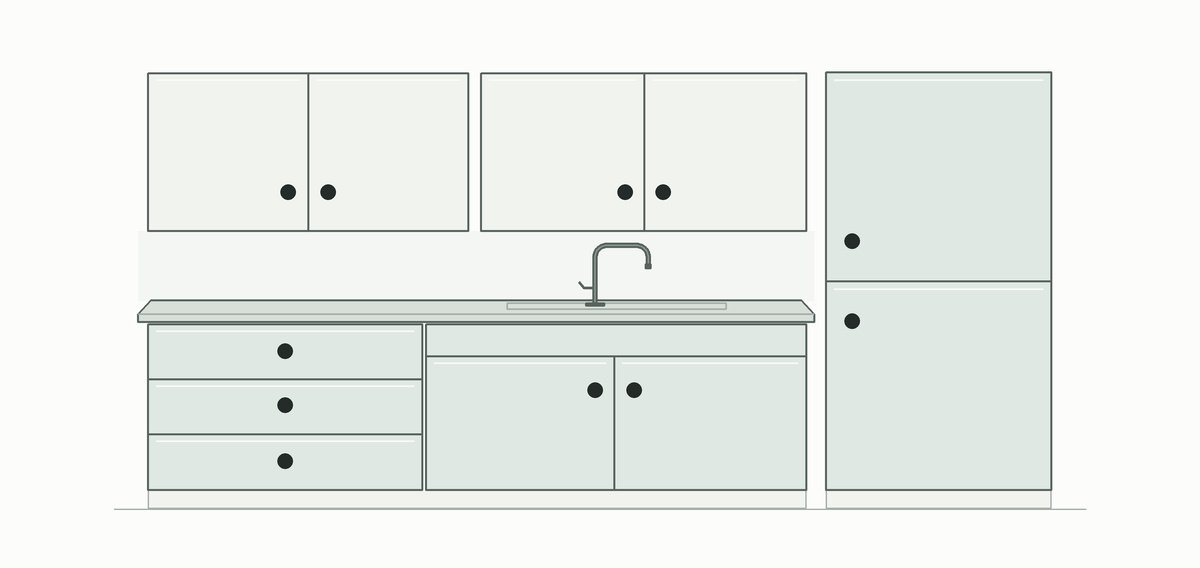
View shopping list for all knobs
- 6 knobs for the upper and sink doors
- 3 knobs for the drawers
- 2 knobs for the pantry doors
11 knobs total
All pulls
Bar pulls repeat a straight line across the kitchen. Use them horizontally on drawers and vertically near each door’s opening edge. The door pulls can use a different length from the drawer pulls.
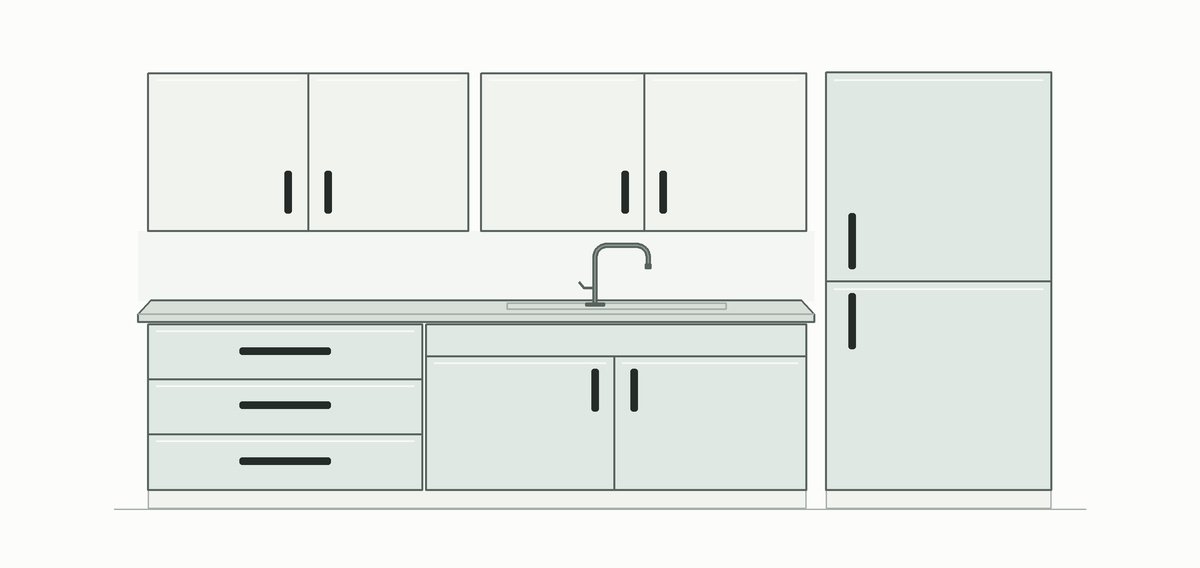
View shopping list for all pulls
- 6 vertical pulls for the upper and sink doors
- 3 horizontal pulls for the drawers
- 2 vertical pulls for the pantry doors
11 pulls total
Knobs and pulls
Use knobs on the upper and sink doors, where a small grip is easy to reach. Give each drawer a horizontal pull and each pantry door a vertical pull. A matching finish ties the two shapes together.
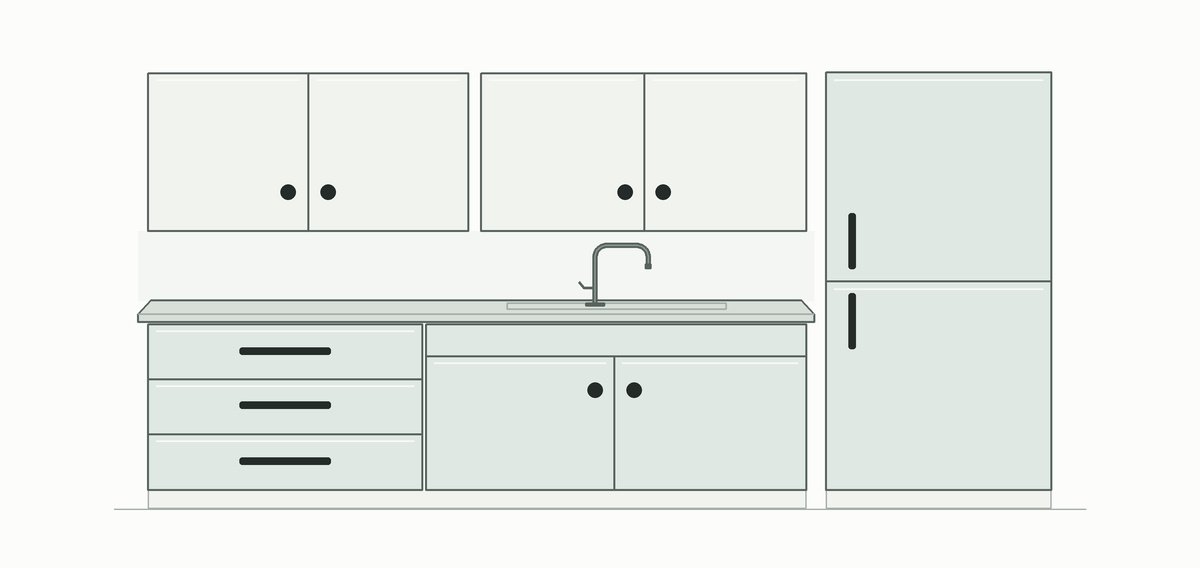
View shopping list for knobs and pulls
- 6 knobs for the upper and sink doors
- 3 horizontal pulls for the drawers
- 2 vertical pulls for the pantry doors
6 knobs + 5 pulls, 11 pieces total
For shallow drawers, try both a knob and a pull. A cup pull suits a front you reach from below. For a paneled appliance, use hardware that meets the appliance maker’s requirements. Explore more knob and pull profiles and placement examples.
See the hardware up close

Smooth Antique Brass Pulls and Knob
A tapered bar and matching knob share a soft brushed finish.
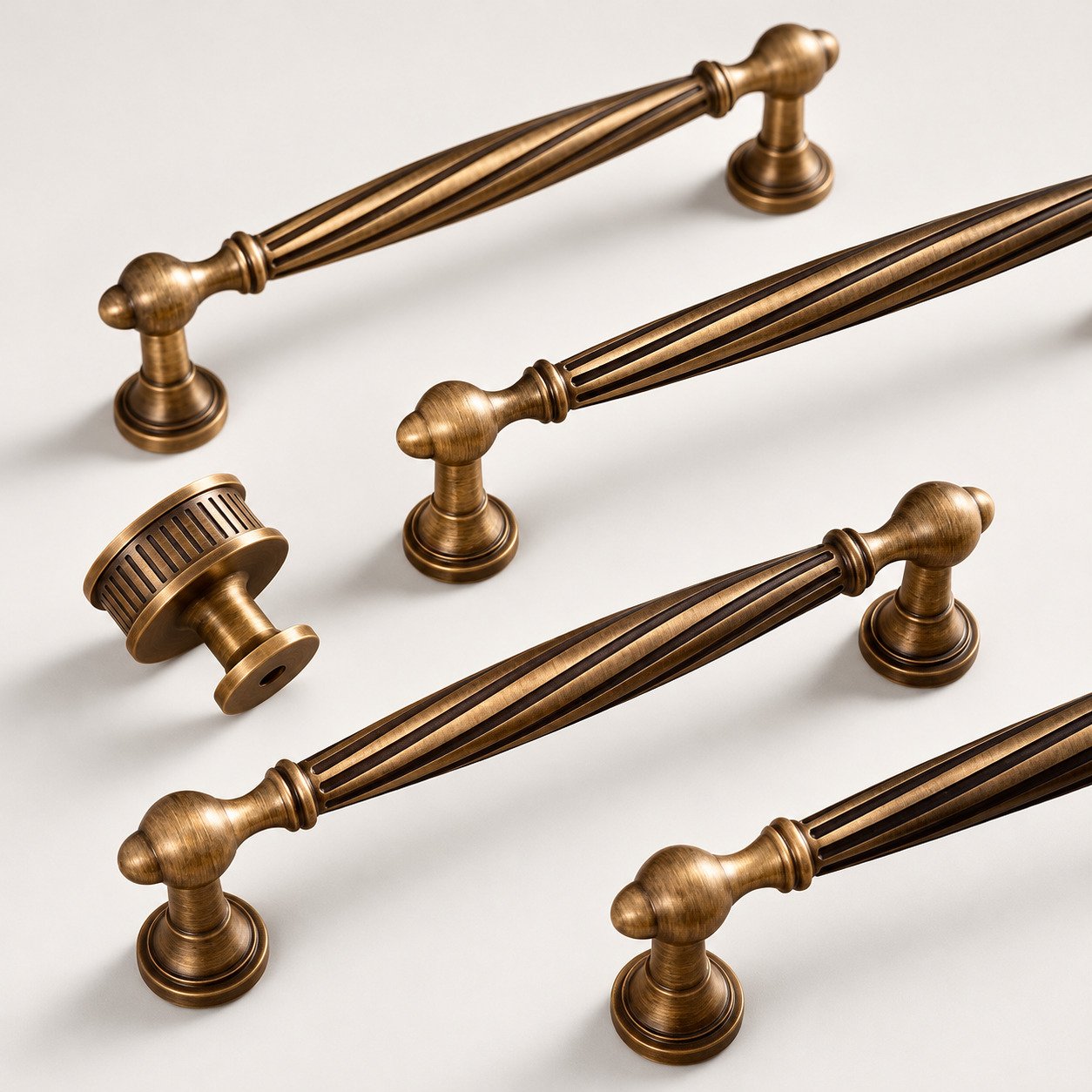
Fluted Antique Brass Pulls and Knob
Deep grooves and rounded ends catch the light. The original catalog composition is shown with a retouched studio backdrop.
Start with the doors and drawers you have
Take off one piece of hardware from each group of matching fronts. A knob usually leaves one screw hole. A pull normally leaves two. Measure between the centers of those two holes, and record that measurement for each group. A handle described as 5 inches long may have a different distance between its screws. For example, 128 mm is just over 5 inches, so check the listed mounting option if your existing holes measure 128 mm. Use our guide to measuring cabinet pulls if you’re working with a tape measure marked in inches.
For new fronts, sketch the cabinet run and mark which way each door swings. Take note of adjacent walls, appliance handles, and drawers that meet at corners. Hold a candidate against the front and check what happens as it opens. A shape that looks good on paper can leave too little room for your fingers beside a wall or bump a handle on the neighboring cabinet.
Once you have the distance between the holes, compare the available mounting sizes for the pull you like.
If you’re switching from a knob to a pull, decide where both screws will land before ordering. The old hole may line up with one of the new screws, or it may need filling. On a painted front, check whether that spot can be touched up. On stained wood, check whether the old base left a lighter or darker patch that the new hardware will expose.
Find a size you can use comfortably
Check overall length and screw spacing separately. Then look at the projection from the cabinet face and the usable gap behind the bar. Projection includes the thickness of the handle. If you need room for your fingers, test the gap on a sample. On undrilled drawers, a paper strip cut to the pull’s overall length lets you judge its proportion from the other side of the room before you commit.
Keep one pull size across similar fronts if you like a consistent line. Try a longer pull on the deepest drawer or tallest door where a small piece feels awkward. A sample of these ribbed brass pulls can help you compare the same profile in different lengths. Open the neighboring fronts with the sample held in position before anyone drills.
Replacing two pulls on a wide drawer? Measure each pair of holes and the distance between the pairs. A single center pull may leave the previous holes exposed. For new drawers, try reaching for one centered handle with the hand you normally use. On a bank of matching drawers, compare the layout from the doorway as well as up close.

Diamond Knurling Up Close
The crosshatched grip is visible on both the bar pull and the matching T knob.
Choose a finish in your kitchen’s light
Put a sample against the actual cabinet door beside a section of counter or backsplash. Check it by the window during the day, then again with your usual lights on. Brushed brass hardware can add warmth to a pale front. A round chrome-finish knob gives a painted door a cooler, brighter highlight. If the faucet and hardware are different metals, repeating one finish on several adjacent fronts helps the choice look deliberate.
Compare the grip at the same time. Texture may matter on a drawer you open several times a day, even if it’s barely visible across the room. Our guides to knurled and smooth cabinet hardware and finishes for white and oak cabinets show the differences up close.
Below, ribbed brass stands out on white, while a slimmer brass profile picks up the warmth of dark wood. Hold a sample against your own door to see how the finish reads beside your countertop.

Ribbed Brass on White Shaker Doors
Long vertical pulls stand out against white framed doors.

Angular Brass on Dark Wood
A brushed pull catches the light below a dark stone countertop.
Check your order before you buy
Open the shopping list under the layout you prefer, then count the working fronts in your own kitchen. Record the exact finish, mounting option, and number of pieces. If the same style comes in two lengths, list each length separately. Check the quantity in the package before you order.
For replacement hardware, confirm the screw spacing and check whether the new bases cover any old marks. For new hardware, check that the supplied screws suit your front thickness. Test a sample on a door or drawer you open often. Keep your order notes with the installation plan so it’s easy to match the right length to each front.
Once the samples work on the fronts you use most, you’re ready to shop. Bring your list with the finish, mounting option, and count when you compare cabinet knobs and pulls.